Showing posts with label Food. Show all posts

Tuesday, September 3, 2013

From a Kernel to a Chip: August Update

Nebraska State Fair, Husker Football, Husker Harvest Days.... that must mean fall is upon us! It is hard to believe how fast the summer went and how quick fall is approaching. Before we know it, we will be harvesting our fall crops, which includes popcorn, corn, soybeans, and last but not least WHITE corn! However, the crops must mature and dry down before harvest can take place, which looks to be awhile.

August was a different month for us as we saw cool and cloudy weather the first couple of weeks and then went straight to dry and hot weather to finish off the month. While the cooler temps were a nice break from some of the heat we dealt with in July, we could have used the sunshine. In order for plants to grow and produce, they need an adequate amount of sunlight as that is the energy source for the plant. When plants, corn in this case, don't receive that adequate amount of sunlight, it can cause the ears of corn to not fill out completely. I have heard many farmers say they have seen some "tip back" in their fields, which could be from the lack of sunlight, hybrid trait, or both. Tip back is when kernels don't fill out to the tip of the ear of corn. This can lead reduced yields if it is wide spread throughout the field. We have seen some tip back in our white corn fields and I am guessing it had to do with us having mostly cloudy weather the first part of August.

Other than seeing some tip back, the white corn crop looks to be good! I forgot to mention that even though we had cool and cloudy weather, we were very fortunate to catch a couple of rains the first part of August that allowed us to take a few days off from irrigating. Unfortunately though, with the rain came some wind, which leaned the white corn over. Now a few of the fields look mangled up and will be a little more challenging to harvest.

As we move into September, we will complete our irrigation's on the corn crops and run the pivots a time or two on the soybeans. By the middle of September, we should be all done irrigating for the season! This year's harvest looks to be a week or two behind compared to previous years. Most likely we wont see much harvesting taking place until the end of September unless things really start to mature and dry down quick. Only time will tell but until then, the next couple of weeks look to be busy getting projects wrapped up and harvest equipment ready before we get into the full swing of harvest 2013!

Below of pictures of the white corn during August:

With the corn being over 10ft tall, it looks like a jungle in the field!
A nice big ear of white corn!
When I broke the ear of corn in half, this is what person sees. The corn cob in the middle and then rows of kernels all around the cob.
If you look closely at a kernel, you can see the starch line that signifies that is is maturing. As the kernel continues to dry down, the line will move lower and everything above it will become hard.
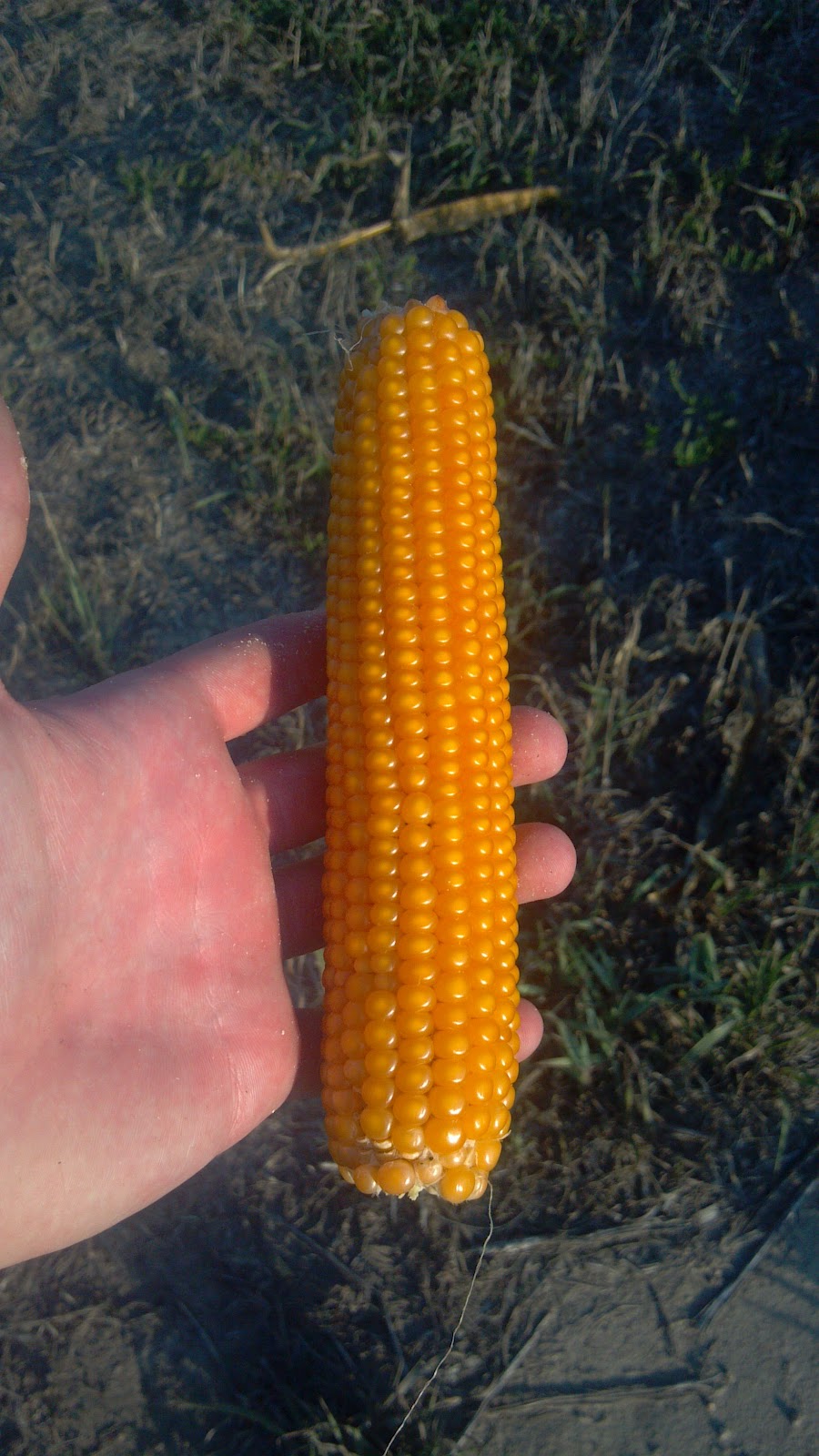
An ear of white corn that I picked from one of our fields. Hope the rest will look like that one!
What the inside of a kernel looks like!

Be sure to check back on October 1st for the next "From a Kernel to a Chip" blog!

To see my previous "From a kernel to a Chip" updates, click here!

Tuesday, August 6, 2013

From a Kernel to a Chip: July Update

In my last From a Kernel to a Chip update, I said we started off with a wet spring and then went to a dry summer. That was true until the middle of July when things started to cool off and we started seeing rain again! The cooler weather was definitely welcomed as the corn began pollinating. Sometimes, like last summer, when it is too hot and does not cool down during the night it can lead to kernels being aborted and an ear of corn not filling out completely. Thankfully it looks like most of the corn has pollinated well this year.

As I mentioned earlier, the beginning of July started off warm and dry. That meant the pivots were running full bore and irrigating seemed like a never ending job. Right after the fourth of July it felt like we almost couldn't keep up due to it being so dry and hot. While we were fortunate to not have too many breakdowns, we did run into a couple stuck pivots. Trying to get a pivot out that is in corn is not fun, especially when it is hot and humid. Unfortunately though, we can't let the pivot be stuck too long or otherwise we would have gotten behind and stressed the corn. However, by the end of July we started getting much needed rain, which allowed us to turn the wells off for a few days. It also helped out the dryland corn. However, some of the dryland corn ended up burning up because it didn't get rain earlier in July.

So far all of our irrigated white corn looks good and we were fortunate to miss bad weather that crossed South Central Nebraska the last week of July. If we can continue to get rain and have decent temperatures, we should end up having a decent crop this year! Only mother nature knows what will be in store for August, and right now it looks like we are going to be seeing cooler temps with a chance of rain almost everyday! So time will tell!

Below are pictures of the white corn during July:

Tassels are just starting to shoot out of the corn. Within a couple of days, all of the tassels popped out of the corn.
In June I showed/talked about creating a ridge in the corn so that water can flow down it. Here is an example of that. We use furrow irrigation on pivot corners or fields where a pivot doesn't work the best.This involves laying out pipe on the headland an then opening up gates to let the water flow out into the rows.
What an ear of corn looks like before the pollination process begins. In order for kernels of corn to develop the pollen must fall on the white silks, which then leads to the development of a kernel.

Once the pollination process has been completed the silks will turn from white to a purple/brown color.
Once pollen has fallen on the silk, it creates the kernels. This is actually called the "blister" stage because the ear of corn looks like it has blisters but is actually the beginning stages of kernel development.
What I usually saw after an evening of irrigating. You just can't beat Nebraska summer sunsets!
Be sure to check back on September 3rd for the next "From a Kernel to a Chip" blog!

Tuesday, July 2, 2013

From a Kernel to a Chip: June Update

Wet Spring - Dry Summer. So far that is how this growing season has gone. It seemed like back in April/May we weren't going to even get a crop in the ground because of how wet it was. Now, it looks like the dryland crops might burn up if we don't get a rain the first part of July. However,  I can't say that has been the case for everyone. Some places around the U.S. are still wet and would be glad to give us some of their moisture. Too bad there isn't a way that we can exchange weather patterns with others!

Since my last "Kernel to a Chip" update, June has ended up being a busy month! The first part of June we cultivated the white corn on the farms that got ridged. The purpose of cultivating is to clean up any weeds that might be growing, which allows us to not have to spray the crop a second time and keeps weeds from using water that could otherwise be used by the corn plants. It also loosens up the soil so that it is easier to ridge the corn for the field that we lay pipe on to furrow irrigate. Due to pivots, we only have to furrow irrigate pivot corners and fields that pivots won't work on due to the lay out of the field. After we ridged the corn (ridging corn creates a ditch for water to flow down), we then laid out the pipe. After the pipe was laid out, irrigation began taking place. We have been irrigating our white corn the last couple of weeks of June due to how dry it has been. We haven't had a good rain for a couple weeks now and the forecast isn't calling for much moisture anytime soon.

As we move into July, we can only hope that Mother Nature will bring us some much needed moisture before our dryland crops shrivel up and start looking like they did last summer! However, not matter what the weather does, we will get through it and hopefully end up having a bountiful fall harvest!

Below are pictures of the white corn during June: 

Cultivating the white corn to remove any weeds that might be developing out in the field.
On the left is what was cultivated and on the right is what was ridged. The purpose of creating a ridge to allow the water to flow to the other end of the fields so that the crops can get water.
The corn has really taken off due to warmer temps!
A sight that is seen almost every evening during irrigation! Gotta love summer time!

Even after the corn has grown and now has many roots, you can still see the seed coat of the seed that was planted back in late April.
It might look like a jungle, but it is only corn plants. As the white corn grows taller, it begins to canopy. This shades off the ground and can prevent weeds from growing while also helping keep the moisture from evaporating so quickly after a rain or irrigation event.
In a couple more weeks we will see this come out the top of the corn plant! This is the tassel which will pollinate the corn plants!


This year we are using a water probe that measures the soil water content and salinity. It will help us schedule our irrigating and tell us how much water is in the soil profile. It is also a tool that is helping us increase our water efficiency.
Be sure to check back on August 6th for the next "From a Kernel to a Chip" blog! 


Tuesday, June 4, 2013

From a Kernel to a Chip: May Update

Who would have thought that we would go from a drought in 2012 to seeing almost too much moisture in the spring of 2013?! Over the last few weeks, we have received over 5 inches of rain, way more than what we saw between July and November of last year! However, the moisture we have received has been a blessing and much needed as our soils were bone dry due to the drought last summer. Pasture ponds are starting to fill back up and the grass that we have our cattle out on is looking much better. However, due to the large amount of rain that we have received the last couple of weeks, there has been some fields that have had some flooding issues. This has lead to the drowning out of some crops. Overall, we will take the moisture and I hope that mother nature wont shut it off!

The white corn is looking good and is starting to grow. It started off sluggish and took a little longer to sprout than normal, but that is due to the colder temps that we experienced in late April and early May. However, the white corn has emerged and is looking good; it just needs some more sunshine and warmer days, which corn thrives on. We will soon be cultivating and ridging some of our white corn to get rid of weeds and also create a ditch so that we can irrigate the places that the pivot doesn't reach. Overall, the white corn crop is starting out good and hopefully will turn out good come next fall!

Below are pictures of the white corn during May:

After a week, the white corn seed began to sprout. The root is the first thing to emerge, which is shown in the picture.
Once the root has emerged, then the shoot emerges. Basically the shoot looks like a green spike sticking out of the ground when the corn is emerging.

A few days later the corn plant's leaf's started to show and the root started to grow deeper into the soil.

Thanks to GPS, we can have nice straight rows of white corn! In a few more weeks, this corn will be much taller and will be a darker color of green.
One of my favorite pictures I have taken! I was lucky to be able to catch a double rainbow and put my favorite brand of equipment in the picture! This was actually taken while I drilled soybeans, but I had to share!
Be sure to check back on July 2nd for the next "From a Kernel to a Chip" update!

Tuesday, April 2, 2013

From a Kernel to a Chip!

Chips and Salsa! The most common type of snack at a get together along with the most common type of appetizer found on a menu at most restaurants. Yet, have you ever wondered how that chip ended up in that bowl? If I had to take a guess, you probably haven't. Even when I have chips and salsa, I don't even think about how that chip got there. However, chips don't just magically appear in a bag, and a chip's life doesn't begin in a grocery store.

The corn tortilla chips you have with your salsa dips, nachos, or taco salads actually come from kernels of white corn that are grown in fields across the Midwest! In matter of fact, some of those kernels in your chips might have actually come from my family's farm in Nebraska!

 Every year my family's farm grows white corn that eventually gets sold and made into the corn tortilla chips that can be found in your grocery store's chip isle! Now, growing white corn doesn't just mean putting a few seeds in the ground and then waiting until next fall to harvest it. It takes hard work and care to make sure that we produce a high quality crop that will eventually end up in the food supply! We also make sure that we are supplying consumers with a safe product that they will eventually serve at their get togethers with friends and family!

As consumers continue to grow more curious about where their food comes from, I have decided to do a series again this year called "From a Kernel to a Chip" that will show how white corn is grown as well as the different growth stages of a white corn plant. The series will begin with planting and continue through harvest, which will take place next fall! This blog series will be similar to my "From the Field to the Movie Theater" blog series last year that focused on popcorn production. The first Tuesday of each month I will publish a blog that gives an update about the growth stage of the crop along with some other interesting facts. Not only will I be posting an update, but I will also be posting pictures that will show what the white corn plant looks like as well as the development of the ear of white corn! So I hope that you will find the blog series interesting as well as being able to learn about where your food comes from, in this case where your corn chips come from!

So be sure to check back on May 7th as I will post what has all happened in the month of April! Hopefully by that time, spring will have arrived with warmer weather and we will have put the seeds of white corn in the ground!!

If you are interested in popcorn production, click here!

Wednesday, November 7, 2012

Californians Say NO to Prop 37

We can FINALLY say that election 2012 is in the books, and we now know who our government leaders will be on the federal, state, and local levels for the next few years! While many paid particular attention to the presidential race and congressional races there were other measures on ballots as well, which included amendments and initiatives. One that caught my eye was Proposition 37 that was on the ballot in California.
Proposition 37 was put on the ballot due to the collection of petition signatures that would require manufacturers of food products to label ALL food products containing GMO ingredients (genetically modified organisms). Doesn't sound like a bad idea, right? Well, in reality Proposition 37 could and would have created a nightmare for not only food manufacturers, but also for consumers, farmers, and ranchers! Why? It would involve more regulation, which in the end would drive up the cost of food, and most likely hurt the middle class and low income earners. Also, there was talk that this could open up a legal frenzy, which would allow people to sue food manufacturers, possibly even farmers or ranchers, because of mislabeling of food products or accidentally having GMO contamination. All in all, Proposition 37 could have been bad news for both the food industry and the agriculture industry! Thankfully, Californians voted against Proposition 37 by a fairly wide margin of 54% to 46%. Many that opposed Proposition 37 stated that it was too complicated and hard to understand. Some have suggested that if it was more organized, it would of had a better chance of passing.

Supporters of Proposition 37 say they deserve the right to know where their food comes from and what is in it, and I agree with them 110%! All Americans deserve to know where their food comes from and how it is being produced. However, I don't believe regulating the food and agriculture industry is the best way to solve their questions. I think that if consumers really want to know where and who is producing their food they need to do some research. There are many farm and food organizations that have formed in the last few years to help consumers make educated decisions when deciding what to buy at the grocery store. Also, if consumers are worried about products containing GMO ingredients they can choose to buy organic brands, which are suppose to be GMO free. So consumers are already being given the choice of being able to choose GMO free products,  a person just needs to look for the "organic" signs.

Although Proposition 37 failed in California, I believe many of us in the agriculture industry need to realize that people want to know what is in their food. We also need to help consumers overcome this fear about food coming from GMOs. So far GMO food products have been proven to be safe and just as healthy as organic products! Trust me, if GMO food wasn't safe, I wouldn't eat it myself, yet I still seem to be living and as healthy as can be! So when it comes to food, yes, consumers have the right to know, but not the right to regulate based off of fears from misleading information when it comes to GMOs.

If you want to learn about where your food comes from, here is a list of groups that provide information regarding the production of food! 

Tuesday, September 18, 2012

Popcorn Harvest!

Harvest has officially started on our farm! We just began and finished our popcorn harvest this last week and now are moving on to soybeans and dryland corn. This year we only grew one pivot (150 acres) of popcorn, so it only took about two days to harvest. Popcorn harvest isn't any different than harvesting other crops since we use the same equipment. However, we do have to make sure the equipment is clean and free of any debris. Since our popcorn is a food grade crop, which goes to the consumer to eat, we have to make sure that we do not contaminate the popcorn with anything, such as dirt and other grains. This means we have to clean out all the trucks, grain cart, and combine to insure the equipment is free from any of this.

While the popcorn is being harvested, it can be transported and stored at an elevator that accepts popcorn or stored on the farm for a short period of time. We opt to store our popcorn in a grain bin until January. The reason for this is due to the fact that we contract our popcorn to ConAgra, which has their popcorn facility located in Hamburg, Iowa. This allows us to continue harvesting the crop without having to stop and transport the popcorn to a plant that is over two hours away.

When we do haul our popcorn to the processing plant, they will first check the popcorn to make sure it is free of any debris and that the moisture of the popcorn is under 15. If it has any debris, or the moisture is over 15, the elevator will charge a fee to the farmer since it is not the best quality. So that is why it is very important that farmers be cautious when harvesting the popcorn to make sure other grains and dirt do not get mixed in with the popcorn. After they have check the popcorn, we dump it and then the popcorn goes through a cleaning process and then gets prepared to be shipped out to movie theaters and homes!

Listed below are some pictures of popcorn harvest taking place. Unfortunately, I wasn't able to help this year due to me being in college. So my family farm's hired hand took the pictures for me!


Close up picture of the combine in action. The corn head (front part of the combine) strips the ears off the plant and then goes through the machine and gets shelled.

After the kernels get shelled from the cob, they go into the grain tank.


We dump the popcorn into a truck that dumps into an auger, where the auger then transfers the popcorn into the grain bin.

When the combine grain tank gets full of popcorn, we unload it into the grain cart. The grain cart then ushers the popcorn to the trucks.

Popcorn is being harvested so that movie goers can enjoy a snack at their next movie!
If you are interested in the growing process of popcorn, be sure to check out my previous blogs by clicking here!


Thursday, September 6, 2012

From the Field to the Movie Theater: September Popcorn Update

Wow, it is hard to believe how fast the summer has gone! Seems like we were just planting the popcorn crop yesterday and now we are getting closer to harvesting it! Yet, I think many farmers are anxious to get their crops out of the field and move on to another growing year that hopefully won't include a drought. It seemed like no one could catch a rain this last summer or get a break from temperatures that ranged from the low 90's into triple digits. Although it was a very dry and hot summer, some crops look fairly decent considering the conditions we faced. Almost all of the irrigated crops look really good while most of the dryland crops looks tough.

So now for the latest update on the popcorn! Unfortunately we didn't receive much rain in August, which meant we had to continue to irrigate the popcorn. However, we didn't have to irrigate the popcorn the entire month of August since the popcorn plants started to dry down and reached their full maturity. When I say the plant started to "dry down", I mean that the plant starts turning a brown color and stops absorbing moisture from the ground. While the plant is starting to dry down, so are the corn kernels. The popcorn kernels start to turn from a light yellow color to a darker yellow color. This is a sign that the popcorn is getting closer to being ready for harvest. Our popcorn will most likely be getting harvested within the next couple of weeks. Usually our popcorn crop is ready before any of our other crops. I will be sure to post a "Popcorn Harvest" blog when we begin the harvest process!

Below are the current pictures of the popcorn crop!

Just a month ago the leaves were a green color and now they have turned to a light brown color. This is part of the drying down process.

An ear that will be ready to be harvested within another week!

Even the tassels dry out.

The size of the plant hasn't changed much since my last blog. However, it's amazing at how fast a popcorn plant can dry down within a month.

One of the ears I picked on the end of the field. Makes a person wonder how big the ears are as you get further into the field.

The cob!

These are what a person will find in the bottom of their popcorn back (the ones that don't pop).


If you would like to see my previous popcorn updates, click here!

Thursday, August 2, 2012

From the Field to the Movie Theater: August Popcorn Update

What a summer it has been so far! This has been one of our driest summers in a long time. I don't think many ever thought that the summer of 2012 would end up being like this. Many farmers all across the United States were expecting a bumper crop this year up until the drought developed. Many of the acres planted to corn or soybeans have been lost due to the dry conditions, which has lead the USDA to lower its yields of those different crops.

Here in South Central Nebraska, we haven't received any rain at all. It has been completely dry where all of our farms are located. Most of the dryland corn has burned up, but so far the irrigated corn looks like it could still yield well. Dryland soybeans still have a chance to yield well if we can catch a rain within the next week, and the irrigated soybeans are doing really good so far.


Unfortunately, our popcorn crop has been in the same boat as our other crops, however, we are very fortunate to have irrigation, which has helped tremendously. In my opinion, our popcorn crop looks very good considering the dry and warm weather we have experienced throughout the month of July. A good portion of July saw temperatures reach into triple digits. When temperatures get that warm, it can affect the pollination process, which could reduce the amount of kernels that develop. Luckily, when our popcorn started to pollinate, the temperatures ended up in the upper 80's to lower 90's. Yet, even with cooler temperatures, we have had to run our pivot almost continuously to keep the popcorn plants watered, as corn plants use a lot of water during the pollination process.

Below are pictures of what the popcorn field and plants look like. It wont be too long before we see a combine out in the field harvesting it!

Places that don't get watered look like this. Unfortunately, the pivot misses this spot. Lots of cornfields around our area that aren't irrigated look like this.

The popcorn kernels have developed. These are what you will eventually find in your bag of popcorn after they have been harvested, cleaned, and packaged.

Every popcorn plant produces at least one ear of corn, however, some plants may produce up to two ears per plant.

When walking out in the corn fields,  a person almost feels as if they are in the Amazon as it looks like a jungle.

The corn plants are almost 10 ft. tall.

The rows of popcorn!!
To read previous popcorn updates, click here!

Thursday, July 5, 2012

From the Field to the Movie Theater- July Popcorn Update

Wow, where has summer gone?! It is hard to believe how fast summer is flying by, and before we know it, it will be over! However, I think the way the weather has been acting so far this summer, some are ready for it to be over with already. It has been a very dry summer so far. Crops are starting to look tough, especially the ones that are not irrigated. Nebraska hasn't been the only one affected by the dry weather this summer. All of the corn belt has been experiencing dry conditions, which has already taken a toll on some of the corn in the eastern part of the corn belt. Although these conditions are not the most "fun" farming conditions to be in, I have been amazed at how positive farmers have been when it could be very easy to get negative about the weather. That is one of the many things I give farmers and ranchers a lot of credit for, is that they wont let anything keep the from doing their job and most of time you will find them trying to make the most out of every situation.

So now to the popcorn update! As I mentioned earlier, the popcorn, along with all the other crops, are currently facing drought conditions. We have received very little rain in the month of June and it has put a lot of stress on the plants. Along with receiving very little rain, we have also faced temperatures that have surpassed 100 degrees. Corn (whether it is yellow corn, white corn, or popcorn) actually likes warm weather. However, it doesn't prefer temperatures that get into the 100's. This actually puts the plant under stress, which can eventually affect yield. Currently, the popcorn is starting to tassel, so that is where the plant will begin the pollination process that will lead to the production of popcorn kernels. However, extremely warm temperatures can actually reduce the amount of kernels produced, which then leads to a reduction in yield that can eventually lead to a lesser supply of popcorn.

Luckily, we are fortunate enough to live in an area where we can use irrigation to water our crops. This has helped tremendously since we have received very little rain. We have been running our pivots on our popcorn fields to try and help reduce the stress on the plants so that we can optimize the yield. So far the popcorn looks really good thanks to the use of irrigation!

 Below are some of the current pictures of what the popcorn looks like!

Because of dry conditions in our area, we have been using irrigation to water our popcorn along with our other crops. Hopefully mother nature will bring us moisture soon!

The popcorn has gotten taller and now allows very little sunlight into the rows. It almost looks like a forest/jungle!

The tassels are just starting to appear in the corn! This is the beginning of the pollination process that leads to the formation of kernels.
This is what the popcorn plants look like out in the field. The size of the plants vary but are roughly around 66 inches tall.
The formation of the ear of POPCORN! It is really tiny right now, but this is the part of the plant that the kernels will eventually develop on. As July continues, this tiny ear will become much larger. 

 If you are interested in previous posts about popcorn, you can click here!